Does a temperature increase automatically create stress?
Heat a 200 mm bar by 40 K with E = 70000 MPa, A = 100 mm² and α = 23×10⁻⁶/K. Compare free, equal-stiffness and rigid axial restraint.
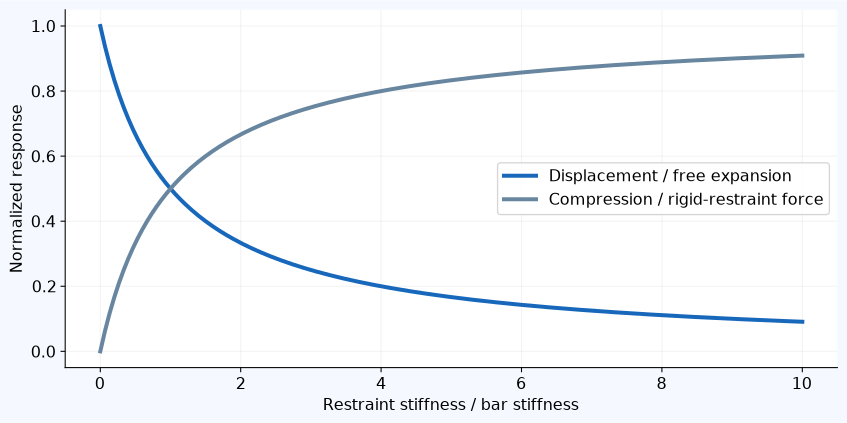
Thermal strain describes the shape change the material would choose freely. Stress arises from the portion the restraint prevents. The bar and restraint share that displacement budget, which is why identical temperatures can produce different stresses.
Connect the physical quantities
A uniform temperature rise does not create stress in a completely free uniform bar. Stress appears when mechanical constraints prevent its stress-free expansion. Thermal strain is therefore an eigenstrain that must be subtracted from total strain before applying elasticity.
The relationship used in this example
A uniform temperature change creates a stress-free thermal strain. Stress appears when the structure cannot accommodate that strain. The reference model is a uniform axial bar fixed at one end, with its other end restrained by an initially unstressed spring connected to ground. Lateral deformation remains free.
Work through the example
Free strain is 23×10⁻⁶×40 = 0.00092; free growth is 0.184 mm.
Equal bar and restraint stiffness split that growth equally: 0.092 mm each.
Restraint force is 35000×0.092 = 3220 N; bar stress is −32.2 MPa.
Full example conditions and reference values
Illustrative aluminum-like constants: E = 70,000 MPa, A = 100 mm², L = 200 mm, α = 23 × 10⁻⁶ K⁻¹ and ΔT = 40 K. Free expansion is 0.184 mm and kb = 35,000 N/mm. With K = kb, displacement is 0.092 mm, compression is 3,220 N and axial stress is −32.2 MPa. Fully preventing axial expansion gives −64.4 MPa. These constants are illustrative and do not identify a qualified alloy.
Compare the numbers before judging the result
| Condition | Opening (mm) | Stress (MPa) |
|---|---|---|
| Free | 0.184 | 0 |
| K=EA/L | 0.092 | -32.2 |
| Axially fixed | 0 | -64.4 |
The restraint converts prevented thermal expansion into elastic compression.
What the result means for a model
A temperature gradient can bend a free structure even without an external axial restraint. Different expansion coefficients in bonded layers also cause internal constraint. Specify stress-free temperature, assembly sequence and whether properties vary with temperature.
For an enclosure, include expansion of the restraint if it shares the temperature change. Treating the cell as hot and the surrounding structure as dimensionally fixed is a specific load case, not a general thermal-expansion model.
Another application: The same temperature rise with different restraint
The example bar grows freely by 0.184 mm. With an equal-stiffness restraint, half appears as opening and half as elastic compression. Removing the restraint gives zero axial stress; a rigid restraint gives −64.4 MPa. Temperature alone does not determine stress.
Further modeling details
Choose the temperature reference
Specify the stress-free temperature and the initial temperature separately. For temperature-dependent expansion data, distinguish instantaneous coefficients from total expansion coefficients referenced to a temperature. Apply the convention expected by the material model.
Understand the restraint
K = 0 gives free expansion; increasing K converts more free expansion into elastic compression. The spring is an effective load-path model, not automatically a bolt stiffness or an entire pack-frame stiffness. Identify the actual constraints before assigning it.
EV pack interpretation
Cooling plates, housings, cells and adhesive layers can expand differently. A uniform bar provides an order-of-magnitude check, but temperature gradients can bend a cover and differential expansion can load interfaces. Electrochemical swelling is a separate eigenstrain mechanism.
Verify the coupled workflow
Check thermal boundary conditions and temperature units first, then map the temperature field to the mechanical model. Run free-expansion and restrained-bar reference cases. Distinguish a prescribed-temperature mechanics calculation from a solved heat-transfer analysis.
Formula and symbol reference
Open the complete formula reference
| Symbol | Meaning | Unit / convention |
|---|---|---|
| L, A | Initial bar length and section area | mm; mm² |
| α, ΔT | Constant expansion coefficient; temperature change from stress-free state | K⁻¹; K |
| K, kb | Restraint stiffness and axial bar stiffness | N/mm |
| δ, F | End displacement and compressive force magnitude for heating | mm; N |
| σx | Axial stress, tension positive | MPa |
When this example stops applying
The model assumes uniform temperature, constant properties, small strain and bilateral linear restraint without initial load. For cooling, the signed reaction reverses; a compression-only contact could instead open. Fully constrained three-dimensional expansion is not described by the uniaxial −EαΔT formula. Gradients, yielding and dissimilar-material assemblies need additional equations.
Check your interpretation
Does a temperature rise necessarily create compressive stress?
Show the reasoning
No. A freely expanding uniform bar has thermal strain but no stress. Restraints, gradients or expansion mismatch are needed to create thermal stress.
Sources and calculation scope
The questions and comparison tables are independently authored teaching examples. Numbers illustrate the stated models; they are not measured cell/pack data or commercial-solver validation.
Comparison calculations (Python)
English / Korean · revised 1 November 2026