Can two states have equal Mises stress but different fracture behavior?
Compare principal stresses [120,0,0] and [200,80,80] MPa. Calculate mean stress, Mises stress and their ratio before discussing any fracture law.
Adding the same pressure-like tensile component to all three principals changes the mean but not their differences. Mises stress depends on deviatoric distortion, while triaxiality retains the hydrostatic contribution. A calibrated fracture relation may therefore distinguish these states even if yielding does not.
Connect the physical quantities
Von Mises stress measures the deviatoric part of stress; triaxiality compares mean stress to that measure. Adding equal tension in all directions leaves Mises stress unchanged but changes the hydrostatic environment. This explains why equal Mises stress does not imply equal ductile-fracture tendency.
The relationship used in this example
Von Mises stress measures the deviatoric part of the stress state. Mean stress describes its hydrostatic part. Their ratio, stress triaxiality, helps distinguish tensile constraint from shear-dominated loading. A fracture model may also depend on a Lode parameter, plastic strain rate, temperature and loading history.
Work through the example
For [120,0,0], mean stress is 40 MPa and q = 120 MPa.
Triaxiality is 40/120 = 1/3.
For [200,80,80], mean is 120 MPa and q remains 120 MPa, giving η = 1.
Full example conditions and reference values
Consider three synthetic states with q = 120 MPa. Uniaxial tension [120, 0, 0] MPa has mean stress 40 MPa and η = 1/3. Pure shear τ = 120/√3 = 69.282 MPa has zero mean stress and η = 0. Adding 80 MPa hydrostatic tension to the first state gives principal stresses [200, 80, 80] MPa: q is still 120 MPa, but η = 1. No fracture strain is assigned to these states without calibration.
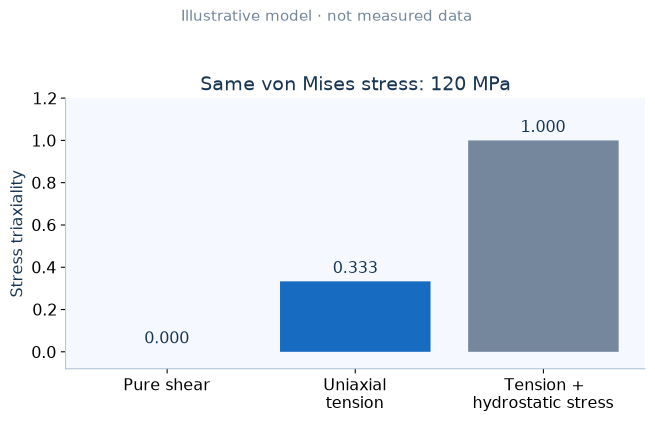
Compare the numbers before judging the result
| Condition | Mean (MPa) | q (MPa) | η |
|---|---|---|---|
| [120,0,0] | 40 | 120 | 0.3333333 |
| [200,80,80] | 120 | 120 | 1 |
Mises stress stays fixed while hydrostatic tension changes. No fracture strain is assigned without calibration.
What the result means for a model
Near q = 0 the ratio becomes poorly conditioned; do not interpret isolated spikes without checking stress magnitude. Fracture calibration may also depend on Lode parameter, strain rate and temperature. Follow the loading history rather than one final contour.
Inspect the triaxiality history where plastic strain accumulates, rather than taking a single maximum across the whole model. Near q = 0 the ratio becomes ill-conditioned; a large ratio in an almost hydrostatic elastic region is not automatically a fracture hotspot.
Another application: Hydrostatic stress changes the state without changing Mises stress
The states [120,0,0] and [200,80,80] MPa differ by 80 MPa hydrostatic tension. Both have q = 120 MPa, but η changes from 1/3 to 1. A pressure-insensitive yield model treats their initial yielding alike; a calibrated fracture law may not.
Further modeling details
Read the loading path
Extract histories at the same material point: equivalent plastic strain, triaxiality and any required Lode measure. A final-frame contour does not show the stress state under which earlier plastic deformation accumulated. Avoid using an averaged nodal value as if it were an integration-point history.
Build a calibration matrix
Smooth tension, notched tension and shear specimens explore different stress states. Record their geometry, boundary conditions and measured observables. Identify the material parameters using the specimen simulations, then reserve a separate specimen or load path for assessment.
EV pack application
A housing corner can combine tensile bending and local constraint, while a fastener region may be shear-dominated. The same equivalent-stress color in those regions does not justify assigning the same failure strain.
Distinguish initiation from erosion
Check whether the plotted quantity denotes initiation, degradation or element status. Deleting elements at an arbitrary strain can hide an incorrect stress-state dependence. Review the force drop and dissipated energy together with the failure path.
Formula and symbol reference
Open the complete formula reference
| Symbol | Meaning | Unit / convention |
|---|---|---|
| σ1, σ2, σ3 | Principal stresses; tension positive | MPa |
| σm, q | Mean stress; von Mises equivalent stress | MPa |
| η | Stress triaxiality when q > 0 | dimensionless |
| ε̄fᵖ | Illustrative stress-state-dependent initiation strain | dimensionless |
| ω | Illustrative initiation index; threshold 1 | dimensionless |
When this example stops applying
Triaxiality is undefined when q is zero. Do not silently replace that state by η = 0. Sign conventions differ: pressure is often positive in compression, giving η = −p/q. The initiation integral is one illustrative family of criteria; it is not a universal ductile-fracture law. Initiation is distinct from subsequent damage evolution.
Check your interpretation
Does a larger triaxiality always mean a known smaller failure strain?
Show the reasoning
No. A calibrated fracture locus and applicable stress-state range are needed. A qualitative trend is not a material parameter.
Sources and calculation scope
The questions and comparison tables are independently authored teaching examples. Numbers illustrate the stated models; they are not measured cell/pack data or commercial-solver validation.
Comparison calculations (Python)
English / Korean · revised 1 November 2026