Are fatigue damage, stiffness damage and a visible crack the same quantity?
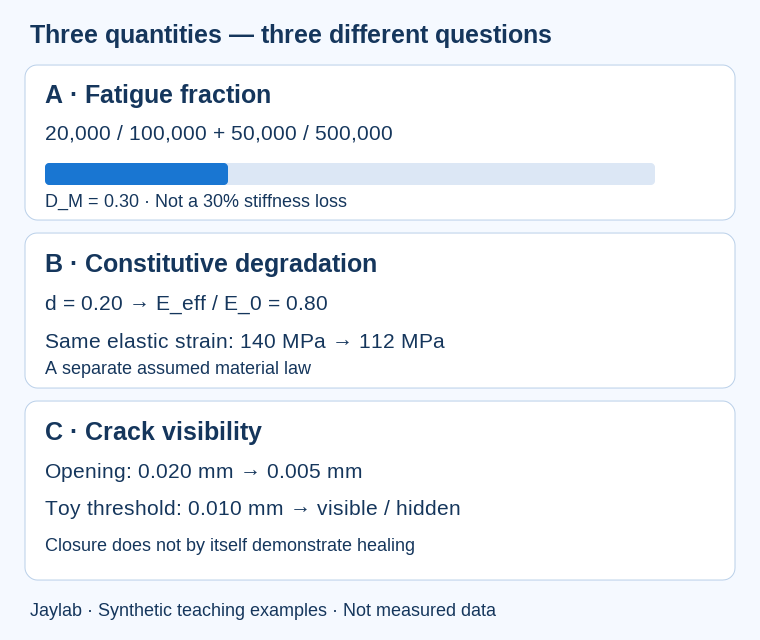
Consider three separate observations: Miner fractions 0.20 and 0.10, scalar stiffness damage d = 0.20, and crack opening changing from 0.020 to 0.005 mm.
These variables belong to different models and measurement rules. A cycle sum measures used model life; d modifies a constitutive stiffness; visibility depends on resolution and loading. No conversion follows merely because all three are called damage.
Connect the physical quantities
The relationship used in this example
Three outputs can describe the same component without measuring the same thing: a fatigue life fraction, an internal material degradation variable and a visible crack. Their definitions, units and endpoints differ. A useful report names the quantity and the observation that could support it, rather than labeling every contour simply as damage.
Work through the example
Count fatigue: 20,000/100,000 + 50,000/500,000 = 0.30. The nominal repetition estimate is 1/0.30 = 3.333 blocks.
Evaluate a separate material model: (1−0.20)×70,000×0.002 = 112 MPa. This is not obtained from the fatigue sum.
Apply the toy visibility rule: 0.020 > 0.010 but 0.005 ≤ 0.010 mm. Visibility changes without any healing law.
Full example conditions and reference values
Three independent synthetic examples: (A) 20,000 cycles with reference life 100,000 plus 50,000 with life 500,000 give DM = 0.30. (B) E0 = 70,000 MPa, elastic strain 0.002 and d = 0.20 give Eeff = 56,000 MPa and stress 112 MPa, compared with 140 MPa when d = 0. (C) A pre-existing crack changes opening from 0.020 to 0.005 mm under compression. An idealized threshold of 0.010 mm changes its visibility from 1 to 0. None of these examples defines a conversion between DM, d and visibility.
Compare the numbers before judging the result
| Condition | d | Eeff (MPa) | Stress at εe=0.002 (MPa) |
|---|---|---|---|
| Undamaged scalar model | 0 | 70000 | 140 |
| Stiffness damage model | 0.2 | 56000 | 112 |
These values follow the chosen scalar constitutive law; Miner D=0.30 from the separate fatigue example is not substituted for d.
What the result means for a model
Name the measured endpoint: stiffness loss, a crack of stated size, leakage or final separation. Link each simulated variable to a measurement that can test its meaning rather than presenting unlike damage scalars on one common scale.
Another application: Closing a crack does not heal the material
The visibility example changes opening from 0.020 to 0.005 mm. Falling below a 0.010 mm detection threshold hides the crack under that observation rule, but does not erase its history. Likewise, Miner D = 0.30 is not automatically a material stiffness reduction of 30%.
Further modeling details
Start with the quantity, not its symbol
Record the model name, location, loading history and endpoint alongside every damage value. Some solvers use uppercase D for constitutive degradation; this chapter uses DM and d only to keep the roles distinct. Changing a letter does not establish a new physical law.
Read a fatigue fraction correctly
In Example A, the contributions are 0.20 and 0.10. A total of 0.30 is not evidence that stiffness has fallen by 30%, nor that a crack occupies 30% of the section. Identical repeated blocks would reach nominal DM = 1 after 3.333 blocks from a fresh state. This is a linear counting prediction, not a guaranteed test life; changing the load order does not change this simple sum.
A constitutive variable needs its own evidence
Example B holds elastic strain fixed while changing the scalar variable. The stress ratio is 112/140 = 0.80 by construction. In an actual specimen, unloading stiffness also depends on geometry, contact, temperature and plastic strain. Do not infer a local d from a whole-assembly stiffness ratio unless a suitable identification model separates these effects.
A closed crack is not automatically healed
Example C changes only the gap of an existing discontinuity. A smaller visible gap can result from compression without restoring bonding across the crack. The threshold rule illustrates a logical ambiguity; real imaging also depends on resolution, orientation, segmentation and contrast. Record those settings and compare equivalent load states.
Prepare a fatigue-to-crush transfer explicitly
Before a subsequent crush analysis, decide which states the receiving model accepts: residual deformation/stress, local plastic history, damage, a discrete crack or changed connections. A Miner map alone does not provide them. For a screening study, compare named assumptions separately and label them as sensitivity cases; a fitted DM-to-d rule needs independent residual-strength evidence.
Keep battery capacity and mechanical damage separate
A mechanical crack metric does not directly specify lost capacity. The structural chapter stops at force, deformation and clearly defined crack or damage observations. Connecting those outputs to electronic isolation or side reactions requires additional mechanisms and data. Treat that as a separate coupling problem, not an automatic percentage conversion.
Formula and symbol reference
Open the complete formula reference
| Symbol | Meaning | Unit / convention |
|---|---|---|
| DM | Miner life-fraction sum; nominal endpoint defined by the method | dimensionless |
| ni, Ni | Applied cycles; reference life at the same cycle condition | cycles |
| d, E0, Eeff | Illustrative degradation variable; original and reduced modulus | dimensionless; MPa; MPa |
| εe, σ | Elastic strain; stress in the illustrative scalar model | dimensionless; MPa |
| w, wmin | Crack opening; assumed observation threshold | mm |
When this example stops applying
The scalar elastic degradation and binary visibility rules are deliberately simplified teaching models. Miner accumulation omits sequence effects. No universal conversion between fatigue fractions, constitutive damage, crack measurements and capacity loss is provided. Actual material calibration and imaging validation are outside this example.
Check your interpretation
If a fatigue contour shows 0.30, may the next crush model simply use 0.70E0?
Show the reasoning
Not without a calibrated, independently checked transfer law. The fatigue sum is not a measured stiffness reduction. Preserve the fatigue definition and identify the states required by the crush material model.
Sources and calculation scope
- Altair · Fatigue life definitions and linear damage accumulation
- SIMULIA · Constitutive damage evolution and element removal
- A. F. Bower · Stress/strain-based failure criteria and fatigue
The questions and comparison tables are independently authored teaching examples. Numbers illustrate the stated models; they are not measured cell/pack data or commercial-solver validation.
Comparison calculations (Python)
English / Korean · revised 1 November 2026