Can a member lose stability far below yield?
Use a 20 mm wide, 3 mm thick strip of length 300 mm with E = 70000 MPa and yield 200 MPa. Compare weak-axis Euler buckling with uniform axial yield.
Yielding limits material stress; buckling concerns whether a straight equilibrium remains stable against lateral motion. Slenderness and end restraint strongly affect the latter. An ideal eigenvalue is a reference, not the collapse load of an imperfect nonlinear part.
Connect the physical quantities
A slender member can lose stability while its stress remains well below yield. Euler buckling reflects stiffness and end constraints of an ideal straight member. Its load is not automatically the collapse load of an imperfect, contacting or plastically deforming assembly.
The relationship used in this example
A compressed member can lose stability while its material is still elastic. Euler buckling describes the ideal bifurcation of a straight, slender, prismatic column. Yielding instead describes the material response. The two checks answer different questions, and neither alone establishes the collapse strength of a real pack component.
Work through the example
Weak-axis I = 20×3³/12 = 45 mm⁴.
Pinned Euler load π²EI/L² = 345.44 N.
Dividing by 60 mm² gives 5.76 MPa, far below the assumed 200 MPa yield stress.
Full example conditions and reference values
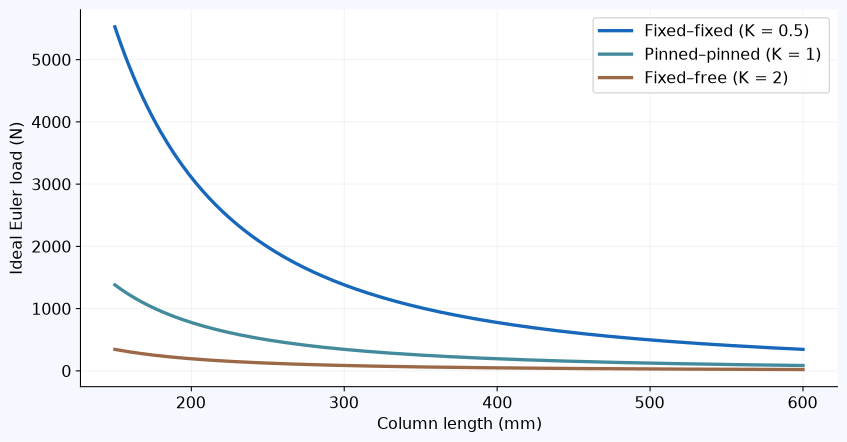
Illustrative strip: width 20 mm, thickness 3 mm, unsupported length 300 mm, E = 70,000 MPa and σy = 200 MPa. Weak-axis I = 45 mm⁴ and A = 60 mm². With ideal pinned ends (K = 1), Pcr = 345.44 N, σcr = 5.76 MPa and λ = 346.41. Uniform axial first yield would require 12,000 N. An ideal cantilever (K = 2) gives 86.36 N; ideal fixed–fixed ends without sidesway (K = 0.5) give 1,381.74 N. These are reference cases, not measured bracket capacities.
Compare the numbers before judging the result
| Length (mm) | Pinned Pcr (N) | Axial yield (N) |
|---|---|---|
| 300 | 345.4362 | 12000 |
| 150 | 1381.745 | 12000 |
Length changes stability without changing the axial area or material yield level.
What the result means for a model
Halving effective length raises the ideal load fourfold. Real joints rarely match a perfect end condition, so compare plausible restraint cases. A linear eigenvalue mode indicates a likely instability pattern; its displayed amplitude is not a predicted deformation.
An eigenvalue buckling factor describes an idealized bifurcation, not the post-buckling load path. If collapse capacity is the objective, include realistic imperfections and nonlinear response, and compare with a relevant test rather than multiplying a nominal load by the eigenvalue alone.
Another application: Length can dominate the buckling estimate
For the pinned strip in the example, halving the unsupported length from 300 to 150 mm multiplies Euler load by four, from 345.44 to 1,381.74 N. The uniform axial yield load remains 12,000 N because area and yield stress are unchanged.
Further modeling details
Identify the bending axis
Compute the second moment for each potential buckling direction. The weak direction can govern even when axial stress is low. Unsupported length refers to effective lateral support, not necessarily the full manufactured part length.
Represent the support physically
Pinned means rotation is free while transverse displacement is restrained. Fixed means both are restrained. A bolted or bonded connection usually has finite compliance; using a fixed face can exaggerate stability. Record why a selected support idealization matches the assembly.
Read an eigenvalue buckling result
An eigenvalue is a load multiplier for a specified reference loading and base state. The plotted mode has an arbitrary scale and is not the actual deflection at collapse. Prestress, contact status and the reference-load definition must be reported with the multiplier.
EV pack application and next check
Use the ideal strip as a check on slender bracket legs or beam-like ribs. For thin covers, crossmember walls or crash-loaded parts, identify local and global instability separately. An imperfection-sensitive assessment requires justified imperfections, geometric nonlinearity and appropriate material behavior; do not tune imperfections merely to obtain a desired load.
Check the restraint factor before trusting a load
For unchanged E, I and L, changing ideal pinned ends (K = 1) to fixed–free ends (K = 2) divides the Euler load by four. Apply the square to the entire effective length KL. For different restraints about two axes, compare EI/(KL)² for both axes rather than choosing the smallest I alone. This is an independent consistency check, not a connection-stiffness calibration.
From an eigenmode to a collapse assessment
First record the preload state and reference load pattern. Then distinguish the eigenvalue multiplier from a nonlinear load–displacement curve. An imperfection must have a justified shape and amplitude, ideally supported by tolerances or measurements. Check sensitivity to imperfection, mesh, constitutive response and contact assumptions. A bifurcation mode scaled for plotting cannot be used as a measured deformation or an allowable load.
Formula and symbol reference
Open the complete formula reference
| Symbol | Meaning | Unit / convention |
|---|---|---|
| E, σy | Young’s modulus; illustrative compressive yield stress | MPa |
| I, A | Second moment about the buckling axis; area | mm⁴; mm² |
| L, rg | Unsupported length; radius of gyration | mm |
| K, λ | Effective-length factor; slenderness | dimensionless |
| Pcr, Py | Ideal elastic bifurcation load; uniform axial first-yield load | N |
When this example stops applying
Euler theory assumes elastic behavior, ideal geometry and ideal supports. Initial crookedness, load eccentricity, residual stress, local plate buckling and inelasticity are excluded. Taking the smaller of Py and Pcr is only a screening comparison, not a design allowable or a general inelastic buckling model. A shell or pack cover is not automatically a column.
Check your interpretation
Will increasing yield strength alone increase the Euler load if E, geometry and supports are unchanged?
Show the reasoning
No. The elastic Euler load depends on stiffness and effective length. Higher yield strength may change an inelastic or material limit, but not this ideal elastic result.
Lecture companions
Sources and calculation scope
- MIT OCW · Buckling of Beams
- TU Delft OCW · Stability and boundary conditions
- The Efficient Engineer · Understanding Buckling
The questions and comparison tables are independently authored teaching examples. Numbers illustrate the stated models; they are not measured cell/pack data or commercial-solver validation.
Comparison calculations (Python)
English / Korean · revised 1 November 2026