Why can an unloaded part stay bent and stressed?
Unload the 20 × 4 mm elastic–plastic section from twice its yield curvature. Use loaded moment 14666.67 N·mm and I = 106.6667 mm⁴.
Assuming elastic unloading without reverse yield, removal of moment subtracts a linear elastic stress distribution. The loaded stress distribution was partly plastic, so this subtraction does not erase it point by point. The remaining stresses self-equilibrate even while the net moment is zero.
Connect the physical quantities
After plastic bending, unloading removes an elastic stress distribution but does not erase the accumulated plastic strain. Some layers can end in compression even though they were tensile at maximum load. Residual stresses self-equilibrate without external force.
The relationship used in this example
Plastic loading leaves an incompatible strain distribution through the thickness. Removing the external moment recovers elastic curvature but need not restore the original shape. For the same symmetric ideal section, assume unloading is elastic throughout and subtract its linear bending-stress distribution from the loaded state.
Work through the example
Elastic curvature recovery is ML/(EI) = 0.00196429 mm⁻¹.
Loaded curvature is 0.00285714 mm⁻¹; subtract recovery to obtain 0.000892857 mm⁻¹.
At y = 2 mm, subtract EΔκy = 275 MPa from loaded 200 MPa to get −75 MPa.
Full example conditions and reference values
Use the 20 × 4 mm rectangle from Elastic–Plastic Bending at κL = 2κy. With ML = 14,666.67 N·mm, the recovered curvature is 0.00196429 mm⁻¹ and residual curvature is 0.000892857 mm⁻¹: 31.25% of the loaded curvature remains. At y = +2 mm, residual stress is −75 MPa; at y = +1 mm, it is +62.5 MPa. The opposite side has opposite signs. The residual field has zero net force and moment despite nonzero local stresses.
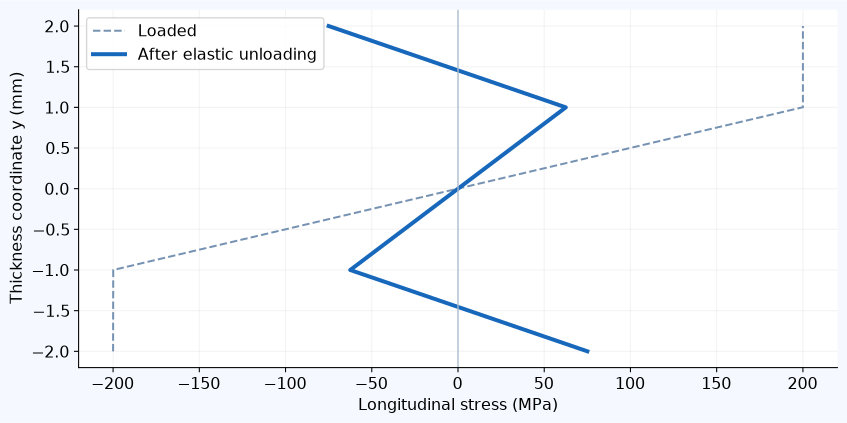
Compare the numbers before judging the result
| y (mm) | Loaded stress (MPa) | Residual stress (MPa) |
|---|---|---|
| 1 | 200 | 62.5 |
| 2 | 200 | -75 |
Two points on the same side can retain opposite residual signs. The complete field, including the opposite side, is self-equilibrated.
What the result means for a model
This calculation assumes elastic unloading without reverse yielding. A cyclic model may change the result. In FE work, preserve the formed material state and remove loads consistently; resetting plastic strain would remove the mechanism being studied.
In an FE unloading step, release the intended loads while retaining only the supports needed to remove rigid motion. Extra displacement constraints can suppress springback and create reactions that belong to the numerical restraint rather than the free part.
Another application: Zero resultant does not mean zero residual stress
After unloading the ideal bent strip, the example retains curvature 0.000892857 mm⁻¹ while net section force and moment are zero. Tensile and compressive residual stresses balance internally. Removing an external load therefore does not restore a stress-free or flat state.
Further modeling details
Distinguish springback and residual deformation
Springback is the recovered portion. Residual curvature is the portion retained after unloading. Report the loaded state, unloaded state and reference geometry rather than calling both quantities deformation.
Test the unloading assumption
Follow the stress path at each thickness position. If reverse yield occurs, subtracting a purely elastic stress distribution is no longer valid; update the constitutive response incrementally. Kinematic hardening matters when reverse loading is important.
Assembly changes the answer
A free strip and a bolted cover do not unload under the same constraints. Fixture removal, contact changes and retained bolt forces can redistribute stress. Preserve the load history when transferring a formed component into a structural analysis.
Use residual stress carefully
Residual stress may influence subsequent yield and fatigue, but the simple profile here is an illustration. A manufacturing-informed assessment needs process conditions, material calibration and measurements or validated process simulation.
Formula and symbol reference
Open the complete formula reference
| Symbol | Meaning | Unit / convention |
|---|---|---|
| κL, κR | Loaded and unloaded residual curvature | mm⁻¹ |
| ML | Moment immediately before unloading | N·mm |
| σL, σR | Loaded and residual longitudinal stress | MPa |
| E, I | Elastic modulus and section second moment | MPa; mm⁴ |
When this example stops applying
Elastic unloading must be checked against reverse yielding; this example remains within ±200 MPa during unloading. Bauschinger effects, cyclic hardening, finite rotations and tooling release are excluded. Zero resultant force and moment do not mean zero stress. A section calculation is not a prediction of the complete released part geometry.
Check your interpretation
Can a freely unloaded part contain stress if its net force and moment are zero?
Show the reasoning
Yes. Self-equilibrated tensile and compressive residual stresses can coexist without external resultants.
Sources and calculation scope
The questions and comparison tables are independently authored teaching examples. Numbers illustrate the stated models; they are not measured cell/pack data or commercial-solver validation.
Comparison calculations (Python)
English / Korean · revised 1 November 2026