Which spring actually stretches in a mode?
Use two 10 kg masses, each grounded by 100000 N/m, with a 50000 N/m coupling spring. Compare in-phase and out-of-phase motion before doubling the coupling stiffness.
In-phase motion moves both masses equally, so the connecting spring does not change length. Opposite motion stretches it. A stiffness change shifts modes according to their deformation pattern, not simply according to its percentage increase.
Connect the physical quantities
A spring contributes only when a mode deforms it. In-phase motion of equal masses does not stretch their coupling spring. Opposite-phase motion does. This makes mode-specific sensitivity more informative than saying that every stiffness increase raises every frequency.
The relationship used in this example
An undamped linear mode is a displacement pattern whose components move at one angular frequency. Its scale is arbitrary. Changing supports changes the stiffness matrix and therefore the frequencies and patterns; changing mass changes the inertia. A frequency shift is evidence about a model, but does not uniquely identify which connection or material changed.
Work through the example
In-phase ω² = ks/m = 100000/10.
Out-of-phase ω² = (ks+2kc)/m = 200000/10.
Convert square roots to Hz: 15.9155 and 22.5079 Hz.
Full example conditions and reference values
Two illustrative equal masses m = 10 kg each have separate ground springs ks = 100,000 N/m and one coupling spring kc = 50,000 N/m between them. The in-phase mode is 15.9155 Hz; the out-of-phase mode is 22.5079 Hz. Doubling only kc leaves the in-phase frequency unchanged and raises the out-of-phase frequency to 27.5664 Hz. If both ground springs are removed, one mode is rigid translation at 0 Hz and the other is relative motion at 15.9155 Hz for the original kc. This is a two-translation teaching model, not a full EV pack simulation.
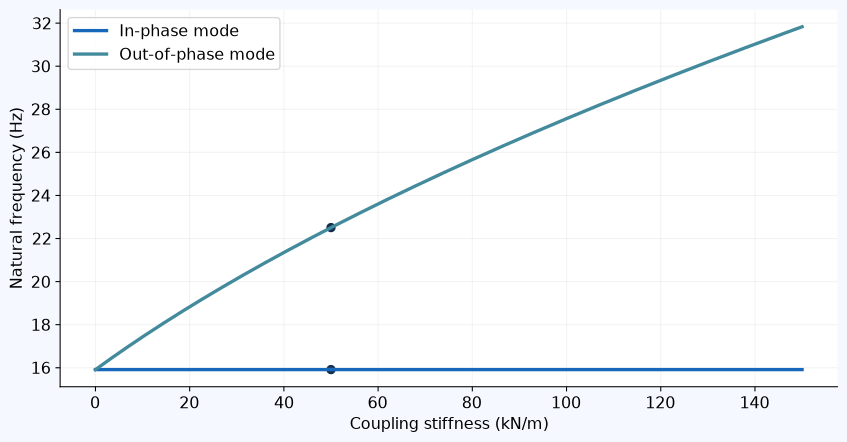
Compare the numbers before judging the result
| kc (N/m) | In-phase (Hz) | Out-of-phase (Hz) |
|---|---|---|
| 50000 | 15.91549 | 22.50791 |
| 100000 | 15.91549 | 27.56644 |
Only the relative-motion mode stretches the coupling spring.
What the result means for a model
If a measured mode shifts when fixture bolts are changed, investigate support compliance before tuning cell modulus. Pair modes by shape as frequencies cross. The first numerical mode is not necessarily the same physical mode in every design.
When a test mode shifts, inspect relative motion across the candidate connection. Pair modes by their shapes and measurement coordinates, since frequency order can change after a design modification.
Another application: Which spring moves in each mode?
In the equal-mass example, in-phase motion does not stretch the coupling spring. Doubling that spring therefore leaves the 15.9155 Hz mode unchanged, while the out-of-phase mode rises from 22.5079 to 27.5664 Hz. Not every stiffness increase moves every mode equally.
Further modeling details
Separate modes from response
A displayed mode is usually scaled for visibility. It is not displacement under an applied load. To predict response, specify excitation location and direction, damping, frequency content and modal participation.
Read the connection energy
Ask which springs or structural regions deform in a mode. A joint can strongly influence one mode but barely affect another. This helps select which measurements are informative for updating a connection model.
Treat free modes deliberately
The free two-mass example has one rigid translational mode because there are only two scalar coordinates. A connected unconstrained three-dimensional body normally has six rigid-body modes. Extra mechanisms, insufficient constraints or missing connections require separate diagnosis.
EV module and pack interpretation
Compare test and model support conditions before tuning elastic moduli. Include fixture compliance, representative module mass and assembly contact state where relevant. Match both frequency and mode shape; use independent load cases to check whether an update generalizes.
Mass normalization and direction-specific participation
Choose a consistent normalization before comparing modal amplitudes. With φᵀMφ = 1, the modal mass is unity in the chosen coordinate convention; this does not mean the structure has unit physical mass. For a specified influence vector r, effective mass is (φᵀMr)²/(φᵀMφ). Report the direction, included modes and relevant total mass. A mode may exist yet contribute little to a particular base-acceleration input.
Inspect the zero-frequency solution
A zero eigenvalue is not a sinusoidal vibration with finite period. In an unforced, undamped free direction, displacement is C + Vt. A near-zero result can represent intended rigid motion, a disconnected component, a mechanism or numerical error. Inspect the shape and connection graph before adding restraints merely to remove it.
A minimal test–model comparison record
Keep total mass, mass distribution, mounting arrangement, preload and fixture state alongside each frequency. Compare shape correspondence as well as frequency differences. If a stiffness update improves one frequency but worsens another, inspect which connections store strain energy in each mode. Reserve physical validation for actual independent test comparisons.
Formula and symbol reference
Open the complete formula reference
| Symbol | Meaning | Unit / convention |
|---|---|---|
| m | Each of two equal lumped masses | kg |
| ks, kc | Each mass-to-ground support stiffness; connecting stiffness | N/m |
| M, K | Mass and stiffness matrices for the two translation DOFs | kg; N/m |
| ωi, fi | Angular natural frequency; cyclic natural frequency | rad/s; Hz |
| φi | Mode vector, arbitrary normalization | relative displacement |
When this example stops applying
No damping, rotational DOFs, distributed structural flexibility, prestress, nonlinear contact or excitation is included. Exact in-phase/out-of-phase results rely on equal masses and symmetric ground springs. Natural frequencies alone do not determine forced-response amplitudes. Near-zero modes need interpretation against the intended free directions and solver tolerance, rather than automatic removal.
Check your interpretation
Why does increasing the connecting spring stiffness not change the in-phase frequency in this symmetric example?
Show the reasoning
Both masses move by the same amount, so the connecting spring does not extend in that mode. Its strain energy is zero; only the ground springs contribute.
Lecture companions
Sources and calculation scope
- MIT · Normal modes of masses connected by springs
- NPTEL · Two-degree-of-freedom undamped vibration
- MIT OCW · Physics III: Vibrations and Waves
The questions and comparison tables are independently authored teaching examples. Numbers illustrate the stated models; they are not measured cell/pack data or commercial-solver validation.
Comparison calculations (Python)
English / Korean · revised 1 November 2026