Does a smaller time increment remove real inertia?
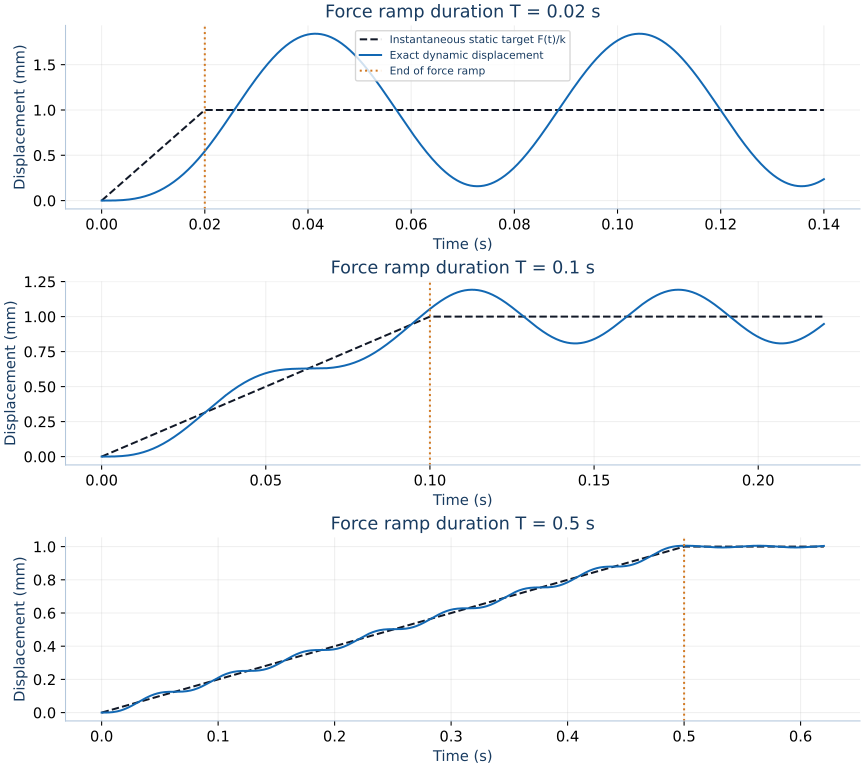
Ramp a force from zero to 10 N on m = 1 kg, k = 10000 N/m with no damping. Compare force-ramp durations 0.02, 0.10 and 0.50 s.
Changing the numerical increment improves integration of a given load history. Changing ramp duration changes the physical loading history itself. An undamped system retains vibration after the ramp; this persists even in the exact solution and is not a convergence defect.
A dynamic calculation used for a slow response
Quasi-static explicit analysis retains inertia in its equations but aims to make its influence small for the intended response. It is useful for some difficult contact paths, yet the label does not remove acceleration. Separate loading duration T from integration increment h: smaller h integrates the same dynamic event more accurately; larger T changes the event itself.
Derive the inertial lag under a ramp
Use m=1 kg, k=10000 N/m, no damping, zero initial displacement and velocity. Ramp the applied force from zero to F0=10 N over T, then hold. The instantaneous static target is F(t)/k. During the ramp a particular solution is F0t/(kT); adding the homogeneous sine needed to satisfy zero initial velocity gives the solution below.
How much motion remains after loading?
The final static displacement is 1 mm. After T, the response oscillates around 1 mm. Its amplitude comes from the displacement error and velocity at the end of the ramp: A²=(uT−F0/k)²+(vT/ω)². Substitution yields the residual-amplitude formula above. The table also reports the largest ramp displacement error normalized by the final 1 mm target, not by a near-zero instantaneous target.
| T (s) | Max ramp error / 1 mm | Residual amplitude / 1 mm |
|---|---|---|
| 0.02 | 50.000% | 84.147% |
| 0.1 | 10.000% | 19.178% |
| 0.5 | 2.000% | 0.529% |
Interpret the comparison without hiding dynamics
At T=0.02 s the residual amplitude is about 0.841 mm, even if time integration is exact. Refining h will not remove it. At T=0.5 s the amplitude is about 0.00529 mm, while the maximum ramp lag is 0.02 mm. These are different criteria. The exact ramp formula is independently checked against RK4 in the reproduction script.
A duration equal to an integer number of natural periods can cancel the final vibration in this ideal system, while motion during loading still differs from static response. Therefore do not choose duration from one favorable final sample. A smooth ramp avoids abrupt velocity/acceleration changes but does not make an arbitrarily short event quasi-static.
Compare the numbers before judging the result
| Ramp T (s) | Static target (mm) | Residual amplitude (mm) |
|---|---|---|
| 0.02 | 1 | 0.841471 |
| 0.1 | 1 | 0.1917849 |
| 0.5 | 1 | 0.00529407 |
Residual amplitude follows the exact undamped force-ramp solution. A small value at one duration can include phase cancellation, so inspect the full ramp history too.
Use a force–displacement and energy comparison
For a rate-independent pad or bracket model, keep mesh, contact and material fixed and compare several durations at matched displacement. Examine reaction oscillation, peak, loading work, local contact sequence and residual deformation. Inspect kinetic energy in the deforming assembly, not only a total dominated by rigid tools. Near startup, internal energy is almost zero and KE/IE can be misleading.
A viscoelastic pad changes force when duration changes because relaxation has more time to act. This physical rate effect must not be removed by choosing an artificial rate. Hold physical duration fixed when investigating mass scaling, and compare with a less-scaled reference. Numerical damping can suppress ringing while changing force; quiet curves alone do not establish accuracy.
What this ramp example does not represent
This is a force-controlled linear oscillator with no contact or damping, not a displacement-controlled compression test. It demonstrates inertia and time-scale effects. Nonlinear stiffness changes the relevant frequencies during loading. Actual impact intentionally contains kinetic energy; it should not be forced to meet a quasi-static energy rule.
Which parameter should change?
If h/2 reproduces the same oscillatory reaction, integration error may already be small while inertia remains important. Investigate T and the physical load path next. If T changes a viscous response, separate material rate dependence from inertia with controlled models or independent measurements rather than declaring the slower answer correct.
Sources & reproduction
The official references document algorithms and solver scope. Derivations, examples and figures here are independently constructed for the stated assumptions. Numerical checks do not replace battery tests or commercial-solver verification.
- Abaqus 2025 · Explicit Dynamic Analysis — stability and constraints
- Abaqus 2025 · Mass Scaling — fixed, variable and contact mass scaling
Only the Python 3 standard library is required. Download the code and run the command below to generate CSV files and verification results in a new folder.
python3 reproduce.py --out results- Calculation code (Python)
- Newton iterations (CSV)
- Discrete frequencies (CSV)
- CDM time history, h = 0.005 s
- Newmark time history, h = 0.005 s
- Force-ramp response (CSV)
English and Korean share equations, examples, figures and section coverage. Revised 1 November 2026.