Why can equilibrium be found by differentiating energy?
Use a 1000 N/mm spring under a constant conservative 100 N force. Write potential as stored elastic energy minus the force potential term.
A small admissible displacement changes internal and external work. At equilibrium their first-order difference vanishes, producing the force-balance equation. The potential term −Fu is not the work accumulated during a gradual force ramp; the loading history matters for that work.
Connect the physical quantities
Virtual displacement is an admissible imagined perturbation, not a time increment. Stationary potential energy means its first variation vanishes at equilibrium. Stability requires additional information about the second variation; equilibrium and stable equilibrium are not identical.
The relationship used in this example
A virtual displacement is an admissible variation, not an additional physical load step. For static equilibrium, internal virtual work equals external virtual work for every admissible variation. In a conservative elastic system, the same statement follows from stationarity of total potential energy.
Work through the example
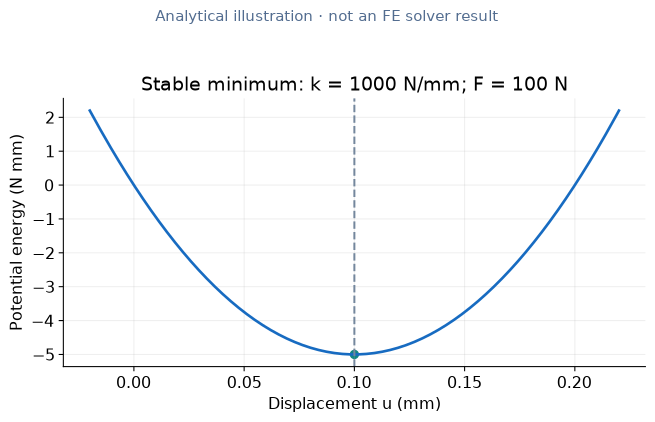
Differentiate Π = 500u²−100u: 1000u−100 = 0.
The stationary displacement is 0.1 mm.
Stored energy is 5 N·mm, force potential is −10 N·mm, and their sum is −5 N·mm.
Full example conditions and reference values
For a synthetic spring with k = 1,000 N/mm and a constant force F = 100 N, Π(u) = 500u² − 100u N·mm. Stationarity gives u = 0.1 mm and Π = −5 N·mm. Stored strain energy is 5 N·mm; the force potential is −10 N·mm. The physical work during a quasistatic force ramp from zero to 100 N is 5 N·mm, so −Fu must not be confused with the accumulated work of that ramp.
Compare the numbers before judging the result
| Trial u (mm) | Π (N·mm) | dΠ/du (N) |
|---|---|---|
| 0 | 0 | -100 |
| 0.05 | -3.75 | -50 |
| 0.1 | -5 | 0 |
| 0.15 | -3.75 | 50 |
| 0.2 | 0 | 100 |
For this positive-stiffness spring, the stationary value is also a minimum. Negative potential does not mean negative stored elastic energy.
What the result means for a model
The negative potential is not negative stored strain energy. A gradual force ramp does work ½Fu in this linear case, whereas −Fu is the potential of the final dead load. Confusing these quantities introduces a factor-of-two error.
A negative total potential is not negative stored strain energy. The stationary point is an equilibrium; stability requires examining the local variation as well. Contact, nonconservative forces and path-dependent plasticity need their own formulations.
Another application: Potential energy is not accumulated loading work
At u = 0.1 mm with k = 1000 N/mm and F = 100 N, stored energy is 5 N·mm and the force potential is −10 N·mm. Their sum is −5 N·mm. During a linear quasistatic ramp, actual external work is instead ½Fu = 5 N·mm.
Further modeling details
From strong to weak form
Start from force balance, multiply by a test field and integrate. Integration by parts transfers derivatives and exposes traction terms. This reduces the smoothness demanded of the displacement approximation and is the reason ordinary C0 elements can be used in many displacement formulations.
Ritz and Galerkin in context
Ritz chooses admissible trial functions and makes a suitable energy stationary. Galerkin chooses test functions from the approximation space and enforces a weighted residual. They coincide for important symmetric conservative problems, but Galerkin is not limited to problems with this simple energy potential.
Treat constraints consistently
Essential displacement conditions restrict both the trial field and its variations. Applied tractions enter through external work. Reaction forces emerge from constrained equilibrium; an arbitrary extra restraint changes the problem even if it makes a singular matrix solvable.
EV pack interpretation
A tray or bracket deformation model must retain the intended load path and support freedom. An energy calculation is useful for checking a simplified stiffness model, but local contact opening and irreversible deformation need their own constitutive and constraint treatment.
Formula and symbol reference
Open the complete formula reference
| Symbol | Meaning | Unit / convention |
|---|---|---|
| δu | Admissible virtual displacement; zero on prescribed displacement boundaries | mm |
| K, k | Linear elastic stiffness matrix; scalar spring stiffness | N/mm |
| Π | Total potential energy for conservative dead loading | N·mm |
| f, F | Applied displacement-independent force | N |
When this example stops applying
The displayed energy function assumes conservative, displacement-independent loading and linear elasticity. A stable minimum additionally requires positive stiffness on admissible directions. General friction, plastic history and follower forces cannot always be represented by this simple potential. Virtual work does not imply every nonlinear equilibrium is a stable minimum.
Check your interpretation
Does δu represent a finite extra deformation that the structure actually undergoes?
Show the reasoning
No. It is a mathematical variation used to test equilibrium under the constraints.
Sources and calculation scope
The questions and comparison tables are independently authored teaching examples. Numbers illustrate the stated models; they are not measured cell/pack data or commercial-solver validation.
Comparison calculations (Python)
English / Korean · revised 1 November 2026