Will refining the red contour produce a finite peak?
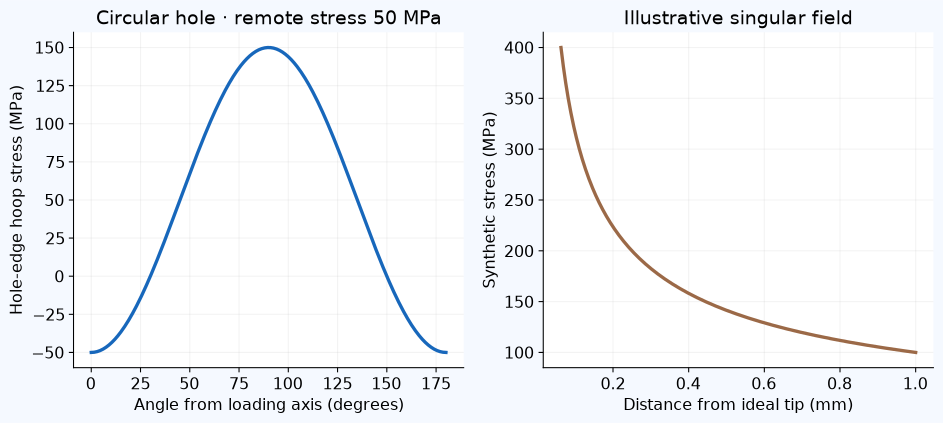
Compare a smooth circular hole under 50 MPa remote tension with a separate illustrative field σ = 100√(1 mm/r) MPa.
A finite stress concentration has a physical limiting value under its assumptions. A mathematical singularity grows as the evaluation point approaches the singular location. Refining both pictures can look similar initially, but their limiting behavior is different.
Connect the physical quantities
A finite-radius stress concentration has a finite elastic peak; a mathematical singularity may grow indefinitely with refinement. Both can look red in a contour plot. Distinguishing them requires checking geometry, boundary idealization and stress trends at defined distances.
The relationship used in this example
A smooth hole or finite-radius notch can produce a bounded stress concentration. A mathematical idealization such as a point load or certain sharp re-entrant corners can instead produce an unbounded local elastic stress. Both can appear red in a contour plot, so color and one mesh cannot distinguish them. Choose the quantity and location being assessed before refining the model.
Work through the example
For the ideal hole, peak stress is 3×50 = 150 MPa.
For the separate singular illustration at r = 0.25 mm, stress is 100√4 = 200 MPa.
At r = 0.0625 mm it doubles again to 400 MPa, showing no finite peak limit.
Full example conditions and reference values
For an infinite, thin, linear-elastic plate with a traction-free circular hole under remote x-direction tension σ∞ = 50 MPa, the hoop stress at the hole edge is 150 MPa at θ = 90° and −50 MPa at θ = 0°. The maximum is finite even though the gradient is steep. As a separate synthetic illustration, σ(r) = 100 MPa × √(1 mm/r) gives 100, 200 and 400 MPa at r = 1, 0.25 and 0.0625 mm. The latter curve illustrates divergence only; it is not a fitted notch law or an FE convergence result.
Compare the numbers before judging the result
| r (mm) | Synthetic singular stress (MPa) |
|---|---|
| 1 | 100 |
| 0.25 | 200 |
| 0.0625 | 400 |
This synthetic divergence differs from the finite 150 MPa circular-hole maximum under the stated infinite-plate assumptions.
What the result means for a model
Choose an extraction method compatible with the design criterion: a finite-distance path, structural stress or fracture parameter may be appropriate. Simply averaging a singular peak until it looks reasonable has no physical justification.
Use the actual radius or a defined distance/area when that is physically justified. Do not move the extraction location after each refinement merely to produce convergence; that changes the quantity being compared.
Another application: A contour maximum needs a location definition
A smooth circular hole in the stated infinite-plate model has a finite 150 MPa maximum at 50 MPa remote tension. In the separate singular illustration, moving from r = 1 to 0.25 mm doubles stress from 100 to 200 MPa. Both can produce red contour bands, for different reasons.
Further modeling details
Use a consistent nominal stress
Define whether nominal stress uses gross area, net area or a remote field. A concentration factor from one convention cannot be multiplied by stress from another. For the hole example, use the remote applied tension, not an arbitrarily averaged nearby value.
Refine the same physical question
Keep geometry, loads and result locations fixed during refinement. Compare the peak, an appropriate stress path and global reactions separately. A stress at a fixed physical distance can behave differently from the maximum at a corner; do not move the sampling point with the mesh and call that convergence.
Check modeling causes
Inspect load footprint, sharp transitions, abrupt restraint edges, tied/contact transitions and element formulation. Introduce a radius or distributed load only when it represents the physical part. Numerical averaging can hide a jump without improving the underlying field.
EV pack application
A mounting-hole edge, weld termination or adhesive end can each need a different assessment. Keep stress component, extraction location, averaging setting and relevant failure criterion in the record. A high local equivalent stress by itself is not a fatigue-life or crack-growth calculation.
Do not apply the same concentration twice
A mesh that resolves a physical notch already predicts its local elastic concentration. Multiplying that local peak by the same Kt again double-counts the geometry. Use Kt with the matching nominal stress for a hand estimate, or compare the resolved FE peak against that estimate under equivalent assumptions. Document the stress component and averaging convention.
A short allowable-load check
For a hypothetical net section A = 600 mm², elastic Kt = 2 and local uniaxial limit 120 MPa, P = A × 120/Kt = 36,000 N. The nominal stress is 60 MPa and the estimated local stress is 120 MPa. The factor must have been defined with this same net-section convention. This is a local elastic screening example, not a multiaxial or fatigue design allowable.
Separate Kt from fatigue and damage
Kt describes an elastic geometric stress ratio. In an applicable nominal-stress fatigue framework, Kf = 1 + q(Kt − 1), where q is notch sensitivity; q requires relevant material and notch information. Do not combine this correction blindly with a local-strain method. Local plastic redistribution, crack initiation and crack propagation require their own constitutive or fatigue/fracture descriptions.
Formula and symbol reference
Open the complete formula reference
| Symbol | Meaning | Unit / convention |
|---|---|---|
| Kt | Elastic stress concentration factor; specify nominal stress convention | dimensionless |
| σ∞, σnom | Remote applied stress; chosen nominal stress | MPa |
| a, θ | Hole radius; angle measured from the remote tensile-load direction | mm; rad |
| r, p, C | Distance to singular point; positive exponent; dimensional coefficient | mm; dimensionless; MPa·mmᵖ |
When this example stops applying
Kt = 3 applies to the stated infinite-plate, circular-hole and uniaxial-loading problem; finite width, net-section definitions, bending or multiple holes change the comparison. A general singular exponent is geometry- and loading-dependent. Removing a maximum from a report does not resolve a real failure risk. Fatigue hot-spot or notch methods require their own defined stress extraction procedure.
Check your interpretation
If refining a sharp corner keeps increasing the peak stress, can the stress be accepted simply by choosing a coarser mesh?
Show the reasoning
No. Establish whether the idealization is singular and whether the assessment needs local geometry, a specified structural stress, fracture mechanics or another defensible measure. A coarse mesh merely masks the behavior.
Lecture companions
Sources and calculation scope
- Jönköping University · Stress concentration
- MathWorks · Plate with circular hole
- COMSOL · Singularities in finite element models
- COMSOL · Evaluating singular stress fields
The questions and comparison tables are independently authored teaching examples. Numbers illustrate the stated models; they are not measured cell/pack data or commercial-solver validation.
Comparison calculations (Python)
English / Korean · revised 1 November 2026