When does the plastic part dominate cyclic strain?
At Nf = 1000 cycles, use E = 200000 MPa, σf′ = 1000 MPa, εf′ = 0.5, b = −0.1 and c = −0.5. Add the elastic and plastic strain amplitudes.
One full cycle contains two reversals, so both terms use 2Nf. The elastic term links stress amplitude to strain through E, while the second term represents cyclic plastic strain. Adding amplitudes does not produce a full range; that requires another factor of two.
Connect the physical quantities
Local strain amplitude contains elastic and plastic contributions. At shorter life the plastic contribution may dominate, which is why stress-only elastic methods can be inadequate for cyclic yielding. The equation uses reversals 2N, even though reported life N is in cycles.
The relationship used in this example
The strain–life approach separates elastic and plastic contributions to strain amplitude. Its coefficients normally come from cyclic testing. The number of reversals, 2Nf, differs from the number of cycles, Nf; this convention must match the fitted data.
Work through the example
For N = 1000 cycles, use 2N = 2000 reversals.
Elastic amplitude is (1000/200000)×2000⁻⁰·¹ = 0.002338.
Plastic amplitude is 0.5×2000⁻⁰·⁵ = 0.011180; sum is 0.013518.
Full example conditions and reference values
For synthetic coefficients E = 200,000 MPa, σf′ = 1,000 MPa, εf′ = 0.5, b = −0.1 and c = −0.5, Nf = 1,000 cycles gives an elastic amplitude of 0.002338 and plastic amplitude of 0.011180. Total amplitude is 0.013518, approximately 1.352%; total strain range is approximately 2.704%. These coefficients are illustrative and are not assigned to a battery component material.
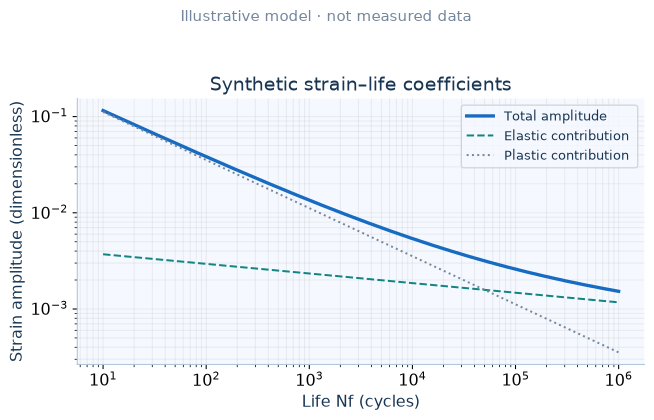
Compare the numbers before judging the result
| Nf (cycles) | Elastic amplitude | Plastic amplitude | Total amplitude |
|---|---|---|---|
| 1000 | 0.002338121 | 0.01118034 | 0.01351846 |
| 10000 | 0.001857236 | 0.003535534 | 0.00539277 |
The synthetic coefficients are fixed; the two contributions decay at different rates as life increases.
What the result means for a model
A strain range is twice the amplitude for the same cycle. Mean-stress treatment and cyclic stress–strain behavior must match the selected method. Do not substitute monotonic tensile coefficients for fatigue coefficients just because their units look similar.
Use the strain measure and stabilized cyclic response associated with the fitted coefficients. A monotonic tensile curve can describe the first loading but cannot alone provide the stabilized hysteresis loop needed for cyclic plasticity.
Another application: Cycles and reversals are not interchangeable
At Nf = 1,000 cycles, the strain–life expression uses 2Nf = 2,000 reversals. Its 1.352% total amplitude corresponds to about 2.704% range. Substituting 1,000 for 2Nf changes both elastic and plastic terms before any material parameter has changed.
Further modeling details
Identify the relevant cycle
Inspect a signed local strain history and determine whether the cyclic response stabilizes. The first excursion, a stabilized loop and a ratcheting history are different inputs. Keep the load sequence and residual deformation available for review.
Choose a consistent localization method
One route uses elastic FE stresses with a local elastic–plastic correction. Another resolves cyclic plasticity directly. Do not apply a plasticity correction again to a history that already includes that effect without a method-specific justification.
EV bracket application
A mount bracket can develop local plastic cycling near a notch while most of the structure remains elastic. Assess whether the local strain history and material test regime support a strain–life approach rather than selecting it from a nominal cycle-count cutoff.
Report sensitivity and uncertainty
Retain coefficient provenance, amplitude conventions, mean-stress treatment and life endpoint. Compare plausible load levels and surface conditions. Small changes in local strain can strongly change predicted life; numerical precision should not be mistaken for material certainty.
Formula and symbol reference
Open the complete formula reference
| Symbol | Meaning | Unit / convention |
|---|---|---|
| εa | Total strain amplitude | dimensionless |
| Nf | Life in cycles; 2Nf is reversals | cycles |
| σf′, εf′ | Fatigue strength and ductility coefficients | MPa; dimensionless |
| b, c | Elastic and plastic strain–life exponents | dimensionless |
| K′, n′ | Stabilized cyclic stress–strain coefficients | MPa; dimensionless |
When this example stops applying
The combined equation here is a baseline without mean-stress correction. Cyclic hardening, mean-stress relaxation, nonproportional loading and creep may require additional treatment. Accumulated equivalent plastic strain is not automatically the signed cyclic strain amplitude. A monotonic tensile curve cannot uniquely identify cyclic fatigue coefficients.
Check your interpretation
If strain amplitude is 0.01, should 0.02 be entered into an amplitude-based strain–life equation?
Show the reasoning
No. 0.02 is the range. Match the equation’s amplitude and reversal conventions.
Sources and calculation scope
The questions and comparison tables are independently authored teaching examples. Numbers illustrate the stated models; they are not measured cell/pack data or commercial-solver validation.
Comparison calculations (Python)
English / Korean · revised 1 November 2026